Vitamin B12: Why It Matters and How to Avoid Deficiency


Vitamin B12 is one of the most important B vitamins: it is needed for normal hematopoiesis, nervous system function and cellular metabolism. It is a water-soluble vitamin, also called cobalamin, and the human body cannot produce it on its own, so it must be obtained from food.
A deficiency usually develops gradually, and the first signs are often nonspecific. That is why it is useful to know where to find B12 sources, how much of this vitamin is needed every day and in which cases it is worth considering additional intake.
What is vitamin B12 and why does the body need it?
Vitamin B12: its role in the body
Cobalamin is the common name for a group of compounds with cobalt at the center of the molecule. In the body, B12 acts as a coenzyme and takes part in several essential processes: the formation of red blood cells, DNA synthesis, energy metabolism and nervous system function.
The nervous system is particularly sensitive to B12 levels, because the vitamin is involved in forming and maintaining myelin – the protective sheath of nerve fibers. That is why a long-term deficiency can manifest not only as fatigue, but also as neurological symptoms.
B12 is also linked to homocysteine metabolism. Homocysteine is an amino acid whose conversion into other substances requires B12, folate and vitamin B6. If any of these nutrients is lacking, blood homocysteine levels can rise.
Vitamin B12 and blood formation
Red blood cells are formed in the bone marrow, and this process requires normal DNA synthesis. If B12 is lacking for a long time, cell division is disrupted and megaloblastic anemia can develop – a condition in which red blood cells become abnormally large while their total number decreases.
If a blood test shows low vitamin B12, it is not just a dietary issue. It is important to find out the cause of the deficiency, because that determines whether a dietary adjustment will be enough or a different approach is needed.
Vitamin B12 in foods and getting it from the diet
The main dietary sources of B12
Naturally occurring vitamin B12 in foods is found mainly in animal products. So when answering the question of which foods contain vitamin B12, the main ones are liver, fish and seafood, meat, eggs, milk and dairy products.
Plant-based foods naturally contain very little B12 or none at all. The exception is fortified products – for example, some plant-based drinks, breakfast cereals or nutritional yeast – to which B12 is added during production. This can be checked in the ingredient list on the packaging.
Table 1. Dietary sources of B12 (approximate)
Food group | B12 content | Notes |
|---|---|---|
Beef and calf liver | Very high | One of the richest sources – even a small serving is enough |
Mussels, oysters | Very high | Seafood is an excellent source of B12 |
Fish (mackerel, herring, salmon, tuna) | High | Also a source of omega-3 fatty acids |
Beef and lamb | Medium | Regular consumption helps maintain levels |
Eggs | Medium to low | B12 is found mainly in the yolk |
Milk, yogurt, cheese | Medium to low | A significant source for vegetarians |
Fortified plant-based products | Depends on the manufacturer | The amount should be checked on the label |
Non-fortified plant-based products | Practically none | Not a reliable source of B12 |
How much B12 is needed every day?
When it comes to getting vitamin B12 daily, people who regularly eat animal products usually need nothing more than a varied diet. Vegans and those who significantly restrict animal foods are advised to get B12 from fortified products or dietary supplements.
The European Food Safety Authority (EFSA) recommends a daily vitamin B12 intake of 4 µg for adults, 4.5 µg during pregnancy and 5 µg while breastfeeding. On dietary supplement labels in the European Union, the reference value (NRV) used is 2.5 µg per day.
When assessing test results, keep in mind that the normal range for vitamin B12 in blood can differ between laboratories. The result should therefore be compared with the reference interval of the specific laboratory and evaluated together with a doctor.
Requirements in childhood
Children need vitamin B12 for normal growth, red blood cell formation and nervous system development. The required amount increases with age – for younger children, it is about 1.5 µg per day, while for teenagers it approaches adult requirements.
A child should not be given products intended for adults without medical advice. If a child's diet is restricted (for example, vegan) or a deficiency is suspected, the most suitable solution should be discussed with a pediatrician.
Deficiency and absorption problems
Vitamin B12 deficiency: signs and risk groups
A deficiency can occur both when B12 intake from food is insufficient and when it is not absorbed well enough. Considerable reserves accumulate in the liver, so signs often appear only after several years.
If the body has too little vitamin B12 for a long time, the following may appear:
- fatigue and weakness;
- pale skin and shortness of breath during exertion;
- difficulty concentrating and memory problems;
- tingling or numbness in the hands and feet;
- inflammation and soreness of the tongue;
- balance problems.
Risk groups include vegans, older adults, people who have had stomach or intestinal surgery, and those who take certain medications long-term. Since these symptoms can also be linked to other conditions, a deficiency should preferably be confirmed with laboratory tests.
Why is vitamin B12 not absorbed?
B12 absorption happens in several stages. First, stomach acid releases the vitamin from food proteins. It then binds to intrinsic factor – a protein produced by the cells of the stomach lining – and only in this complex is it absorbed in the final section of the small intestine.
If any of these stages is disrupted, even an adequate amount of B12 in the diet may not ensure a normal blood level. One specific cause is pernicious anemia – an autoimmune disease in which the body does not produce enough intrinsic factor.
Table 2. The most common causes of B12 deficiency
Cause | How it affects B12 | What to do |
|---|---|---|
Vegan or very restricted diet | Insufficient intake from food | Fortified products or dietary supplements |
Age over 50 | Less stomach acid – the vitamin is released from food less effectively | Check B12 levels regularly |
Pernicious anemia | The body does not produce enough intrinsic factor | Doctor-prescribed therapy, often injections |
Stomach or intestinal surgery | The absorption surface or intrinsic factor production is reduced | Long-term medical supervision |
Intestinal diseases (e.g., Crohn's disease, celiac disease) | Impaired absorption in the small intestine | Treat the underlying disease and monitor levels |
Long-term use of metformin or proton pump inhibitors | May reduce B12 absorption | Discuss a level check with a doctor |
That is why absorption problems cannot be solved simply by choosing a larger dose. At high doses, part of the B12 can also be absorbed passively, without intrinsic factor, but the most suitable approach is determined by a doctor. If the deficiency recurs or is pronounced, a medical evaluation is necessary.
Forms of vitamin B12 and their use
Dietary supplements
In dietary supplements, B12 comes in several chemical forms. Cyanocobalamin is a stable, widely studied synthetic form that the body converts into the active forms. Methylcobalamin and adenosylcobalamin are coenzyme forms that act directly in the body, while hydroxocobalamin is more often used in injections.
Tablets, sublingual tablets, lozenges, drops and vitamin complexes are available. Before use, it is worth reading what the instructions for the specific vitamin B12 product state: the recommended dose, time of intake and restrictions.
Injections and ampoules
In cases of severe deficiency or absorption problems, a doctor may prescribe a course of injections. Vitamin B12 in injection form enters the bloodstream directly, bypassing the digestive tract, which is why this method is used, for example, in pernicious anemia.
Such medicinal forms are used for medical indications and are not a replacement for a daily dietary supplement. If you are interested in vitamin B12 in ampoules, the price should be considered together with the therapy regimen prescribed by the doctor, since comparing the cost of prescription medicines and dietary supplements directly is not valid.
Too much vitamin B12 – is it possible?
Since B12 is a water-soluble vitamin with low toxicity, EFSA has not set a tolerable upper intake level for it. The excess is mostly excreted in urine, and high doses are generally considered safe.
However, this does not mean that any test result can be ignored.
Elevated vitamin B12 in blood – what can it mean?
If a person takes dietary supplements or receives injections, elevated vitamin B12 in test results is most often linked to exactly that.
On the other hand, an unexpectedly high level in a person who does not take extra B12 should be discussed with a doctor. It can be linked, for example, to impaired liver or kidney function or to certain blood disorders, so the result should be evaluated together with other examinations.
Before the tests, it is worth telling the doctor about all the products you take, including multivitamins and energy drinks, to which B12 is often added.
How to choose a vitamin B12 dietary supplement?
Dose, form and composition
First of all, the purpose of use should be determined. If the diet provides an adequate amount of B12, additional intake may not be necessary. In the case of a laboratory-confirmed deficiency, the dose and duration of therapy are determined by a doctor.
When choosing a product, pay attention to:
- the form of B12;
- the amount per serving and the percentage of the reference value (NRV);
- the recommended daily dose;
- the other ingredients, such as folate or vitamin B6;
- the instructions for use;
- the manufacturer's quality management standards (for example, GMP and ISO).
A high figure on the packaging does not always mean a better product – the choice should be adapted to the specific situation.
Vitamin B12 price and value: what to compare?
When comparing products, you should not look only at the total price of the package. It is more accurate to calculate the cost per serving and take into account the amount of B12, the form and the rest of the composition – a complex with several active substances may turn out to be better value than several separate products.
If you need vitamin B12, a pharmacy is not the only place to buy it – dietary supplements are also available in specialized health stores and online shops.
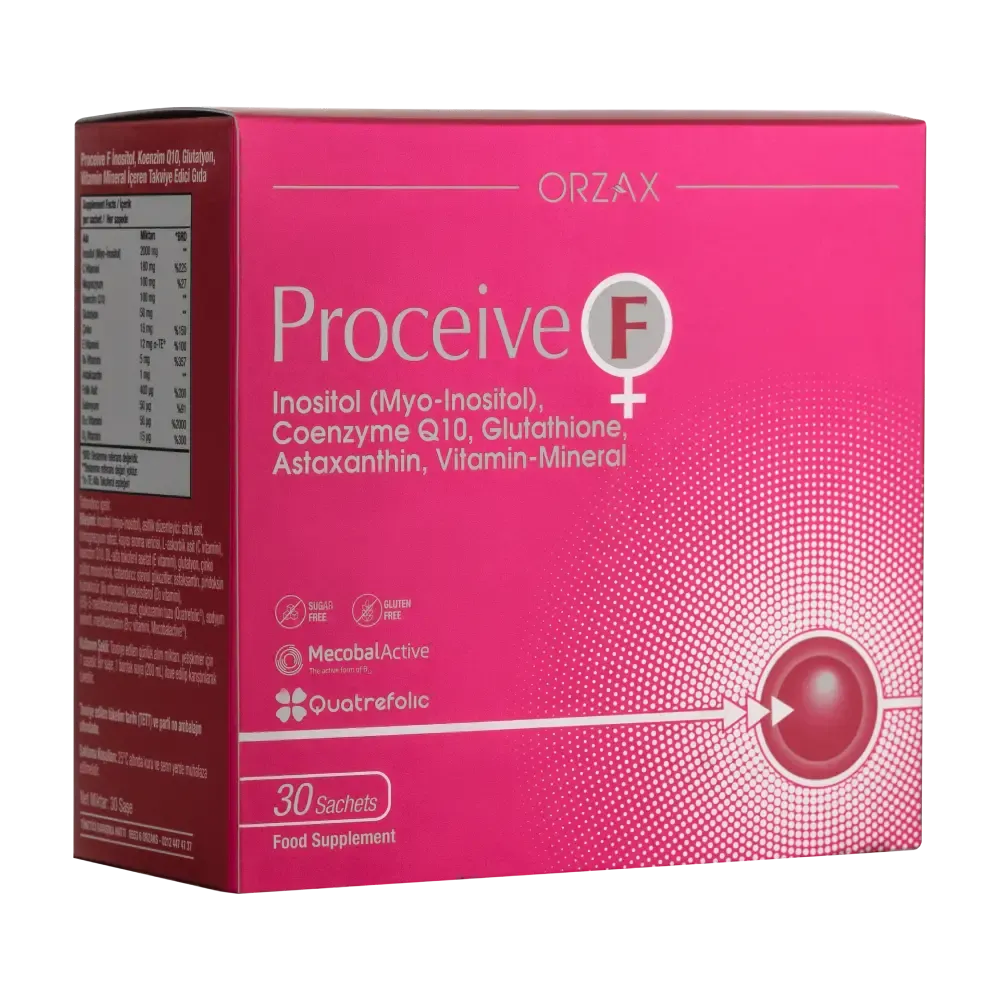
The IQ Beauty catalog offers Orzax vitamin and mineral complexes. For example, Orzax Proceive F – a complex supporting women's reproductive health – contains vitamin B12 in the methylcobalamin form (50 µg per sachet) together with other vitamins and minerals. The manufacturer recommends that adults take one sachet per day. Before buying, it is recommended to check the current composition and usage information on the product page, as the formula and availability may change.
Conclusion
Vitamin B12 is essential for the normal functioning of the body – it takes part in hematopoiesis, nervous system function, DNA synthesis and energy metabolism. The main sources are animal products, while vegans and people with restricted diets can rely on fortified products and dietary supplements.
Special attention should be paid to absorption problems, because in that case a deficiency can develop even with an adequate diet. If a test shows a low or inexplicably high level, it is important to find out the cause rather than just change the dose. When choosing a product, consider the form, dose, composition and instructions for use – a suitable solution can also be found in the IQ Beauty catalog.
FAQ — Frequently Asked Questions







.png&w=3840&q=75)








Thinking about boosting immunity? Start with a -10% discount!
Get a welcome bonus on your first order of premium nutraceuticals.